
|


Sto Corp.: StoCast Lightweight Finishes Combine Design Flexibility with Proven Durability
March 17, 2026
For generations, building durability has often been associated with heavy exterior materials such as brick, stone, and masonry. While these traditional claddings remain widely used, advances in building envelope technology are demonstrating that weight alone does not determine long-term performance.
Today’s high-performance facade systems increasingly rely on engineered materials and integrated wall assemblies to deliver durability, resilience, and energy efficiency. Sto Corp. has developed a range of lightweight exterior finishes designed to replicate the aesthetics of traditional materials while providing improved installation efficiency and long-term performance.
Rethinking Durability in Exterior Cladding
Traditional cladding systems achieve strength largely through material mass. However, these heavier materials can introduce additional structural requirements and installation challenges. Heavy masonry or stone facades often require stronger structural framing, longer construction schedules, and skilled labor to install properly.
Rigid claddings can also be susceptible to cracking or weather-related deterioration over time. Efflorescence, surface cracking, and maintenance concerns are common issues associated with traditional masonry assemblies.
As building design continues to evolve, many architects and building owners are exploring facade solutions that achieve durability through system engineering rather than material weight.
Durability Through System-Based Design
Modern wall systems integrate multiple layers—including air and water barriers, insulation, and reinforced finishes—to create high-performance building envelopes. Sto’s system-based approach combines lightweight exterior finishes with reinforced basecoats and mesh assemblies to help improve impact resistance and long-term durability.
Rather than relying on heavy materials alone, these systems are engineered to perform as a unified assembly. The result is a facade solution that can maintain structural integrity while reducing structural load and simplifying installation.
Sto’s integrated envelope solutions also incorporate continuous insulation and air and water-resistive barriers, helping buildings achieve improved energy performance while maintaining aesthetic flexibility.
StoCast: Lightweight Cladding with Traditional Aesthetics
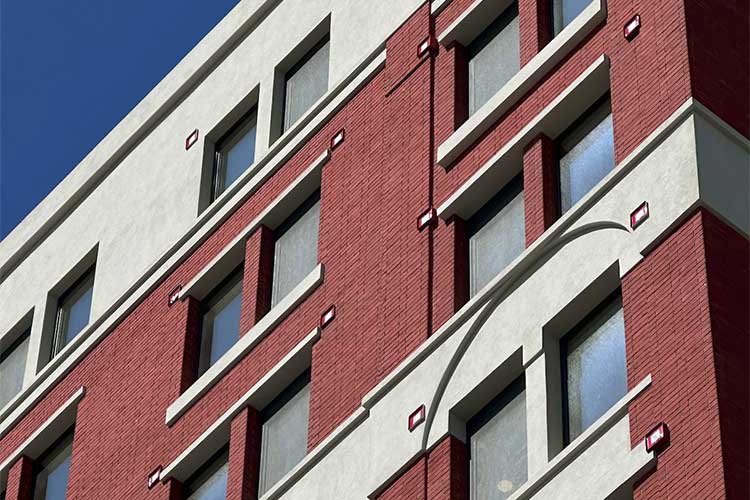
One example of this approach is StoCast, a family of prefabricated resin-cast shapes designed to replicate the appearance of traditional building materials. The components are thin and lightweight while capturing detailed textures found in brick, wood, and other cladding styles. :contentReference[oaicite:0]{index=0}
StoCast elements are flexible and designed for adhesive application, eliminating the need for mechanical fasteners in many installations. When integrated with Sto wall systems such as StoTherm® ci, the cladding becomes part of a complete exterior assembly designed for durability and performance. :contentReference[oaicite:1]{index=1}
StoTherm® ci is an exterior insulation and finish system (EIFS) with drainage that integrates continuous insulation, an air and water-resistive barrier, and reinforced finish layers. This integrated approach allows architects to achieve a variety of aesthetic appearances while maintaining a consistent and coordinated wall system.
Performance and Sustainability Advantages
Lightweight cladding systems can offer several practical benefits compared with traditional materials.
- Reduced structural load: Lightweight finishes place less stress on the building structure.
- Lower transportation energy: Lighter materials reduce shipping weight and associated energy use.
- Reduced material consumption: Thin-profile finishes require less raw material.
- Safer handling: StoCast products are silica-free during handling. :contentReference[oaicite:2]{index=2}
These characteristics can support more sustainable construction while helping contractors streamline installation.
Impact Resistance Demonstrated in Testing
Durability remains a critical concern when evaluating lightweight cladding. To demonstrate performance in real-world conditions, Sto conducted impact tests on StoCast Brick installed as part of a StoTherm® ci system reinforced with Sto Armor Mat XX mesh.
The system was subjected to several impact scenarios designed to simulate potential jobsite or operational damage, including:
- 20-foot steel weighted ball drop
- Baseball bat strike
- Hammer impact
Testing showed that the system maintained its integrity, experiencing only minor cosmetic surface marks that could be repaired without replacing the cladding.
Applications for High-Traffic Environments
Durable lightweight cladding systems can be particularly valuable in areas where building exteriors are exposed to frequent contact or potential impact. These applications include:
- Educational facilities and campuses
- Multifamily and mixed-use developments
- Renovation and recladding projects
- High-traffic urban environments
Because repairs can often be localized, maintenance requirements may be reduced compared with traditional cladding systems.
Expanded Architectural Design Options
In addition to performance advantages, lightweight resin-cast finishes provide design flexibility. StoCast Brick reproduces the look of traditional masonry, while StoCast Wood replicates natural wood grain textures with enhanced durability and reduced maintenance requirements. :contentReference[oaicite:3]{index=3}
These finishes can be integrated into multi-cladding facades and applied to curved surfaces, soffits, and other architectural elements that may be challenging for heavier materials.
Integrated Envelope Systems Reduce Risk
Facade performance depends on more than the visible finish layer. Transitions between components—such as insulation, air barriers, and cladding—play a critical role in long-term building performance.
Sto addresses these challenges through coordinated wall assemblies that integrate multiple envelope components from a single manufacturer. By designing systems to work together, compatibility issues can be minimized and construction risks reduced.
Lightweight Materials for Modern Building Envelopes
Advances in building science continue to shift the focus from material mass to engineered performance. Lightweight facade systems demonstrate that durability, energy efficiency, and architectural flexibility can be achieved through integrated design.
StoCast lightweight finishes illustrate how modern cladding technologies can replicate the appearance of traditional materials while offering advantages in installation efficiency, structural performance, and long-term maintenance.
For more information, read the original article from Sto Corp.:
Lightweight Finishes that Deliver Real-World Durability
@StoCorp #StoCorp #building #offices #stoventec
Company:  Sto Corp.
Source: https://www.stocorp.com/lightweight-finishes-that-deliver-real-world-durability/
Tags: